
tl;dr
A Limited Slip Differential (LSD) manages how much the driven wheels are allowed to rotate at different speeds. Too much lock makes the car nervous, too much slip wastes traction. The sweet spot keeps the inside wheel from spinning while maintaining predictable handling. In Gran Turismo 7, this balance is tuned using Initial, Acceleration, and Braking settings.
Understanding the Limited Slip Differential (LSD)
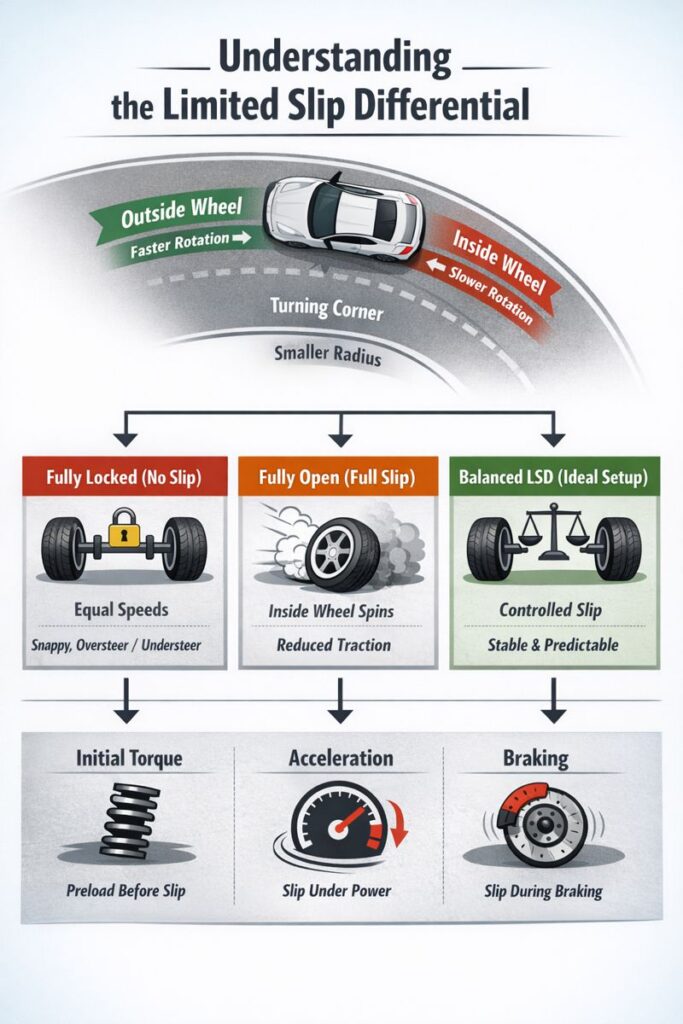
A Limited Slip Differential (LSD) controls the difference in rotational speed between the inside and outside drive wheels. This difference is essential because, when cornering, the wheels travel different distances: the outside wheel follows a larger radius and therefore needs to rotate faster than the inside wheel.
How much freedom the differential allows between those two wheel speeds is referred to as slip. Managing this slip correctly is critical for both traction and vehicle balance.
What Happens at the Extremes?
Fully locked differential (no slip)
When the differential is fully closed, both wheels rotate at the same speed at all times. While this maximizes traction in a straight line, it can make the car very aggressive in corners.
- In rear-wheel-drive (FR) cars, this often results in a snappy rear end and easy oversteer—great for drifting, but tricky for grip driving.
- In front-wheel-drive (FF) cars, a locked diff tends to increase understeer, as the car resists turning into the corner.
Fully open differential (full slip)
With a completely open differential, wheel speed is not restricted at all. The inside wheel can spin freely, especially under power.
- This setup is generally more stable and forgiving.
- However, it reduces effective forward drive, as power is wasted on the spinning inside wheel instead of being transferred to the road.
Finding the Sweet Spot
The ideal LSD setup lies between these two extremes. The goal is to prevent excessive inside wheel spin while keeping the car predictable and controllable.
- FF cars should minimize power understeer without becoming too locked.
- FR cars should maintain traction without sudden snap oversteer.
A well-tuned LSD improves corner exit speed, stability, and overall confidence behind the wheel.
LSD Settings in Gran Turismo 7
Gran Turismo 7 gives you three parameters to fine-tune your differential behavior:
Initial Torque
This acts as a preload. It defines how much force must be applied before the differential starts to allow slip. Higher values make the diff feel tighter even when coasting.
Acceleration Sensitivity
This setting controls how much slip is allowed under acceleration—but only after the Initial Torque threshold is exceeded. Higher values increase traction on corner exit but can also make the car harder to control.
Braking Sensitivity
This determines how much slip is allowed during braking and deceleration. It’s a powerful tool for adjusting corner entry behavior and can help counter entry oversteer or understeer.
As a general guideline, set Initial low, acceleration mid, and braking low. Pay attention to what the car is doing. If the car is too snappy, lower acceleration setting. If the inside wheel is spinning, raise the acceleration setting. If the car oversteers on corner entry, raise braking stability.
In GT7 terms, maximum and minimum LSD settings are circumstantially usable, and attention should be paid to correcting car behaviour and creating an LSD setup that is sympathetic with the suspension set up, tyre choice and driving style.
TCRT Deathscythe
Dialing in these three values correctly can transform how a car behaves, often more dramatically than suspension or aero changes. A good LSD setup doesn’t just add speed—it adds consistency.